
Solar Innovator Review (2026): 3D Spherical Solar, Bill Savings & Orgone Asset Blunder
The Solar Innovator System is a digital instructional blueprint and video course teaching homeowners how to construct a 3D spherical solar generator using compact photovoltaic cells and affordable hardware parts. Inspired by the compound eye of insects to capture omnidirectional sunlight, it is evaluated below against genuine checkout pricing ($39 one-time), photovoltaic physics, its verified 60-day ClickBank guarantee, and an absurd affiliate blunder that recycled Orgone motor assets.
Executive Summary & Overview
With residential electricity rates climbing steadily across the country and utility grid blackouts becoming more frequent, millions of homeowners are searching for ways to generate their own clean, independent power. However, traditional commercial rooftop solar installations often demand $15,000 to $30,000 in upfront capital, complex building permits, and long payback periods.
The Solar Innovator System™ positions itself as an ingenious, low-cost DIY alternative. Marketed as a bio-mimetic 3D Spherical Solar Generator, the system claims to generate significantly more electricity per square foot than traditional flat panels while occupying minimal backyard or balcony space.
Instead of shipping heavy prefabricated panels, Solar Innovator is a structured digital instructional blueprint and video course authored under the name Mark Daniels. Below, we break down the photovoltaic physics of 3D solar arrays, audit genuine checkout pricing ($39 one-time), examine independent YouTube video test results, and expose an absurd affiliate blunder that recycled Orgone motor assets.
What Is It? 3D Spherical Solar Architecture
The Solar Innovator System is an electronic digital instructional guide delivered immediately after purchase via downloadable PDF manuals, schematic diagrams, and companion video walkthroughs. No physical solar hardware is delivered to your residence.
The guide outlines a practical 4-step assembly roadmap:
- Phase 1: Hardware Sourcing & Bill of Materials: A parts shopping list detailing small monocrystalline solar cells, blocking diodes, copper wiring, a 12V solar charge controller, and lightweight framing materials available at standard hardware stores for roughly $150 to $200.
- Phase 2: Geodesic Spherical Framework Assembly: Instructions for constructing a lightweight 3D spherical or domed frame inspired by the compound optical geometry of insect eyes.
- Phase 3: Cell Soldering & Array Wiring: Step-by-step schematics showing how to solder blocking diodes and wire the solar cells in series-parallel configurations to optimize output voltage (typically 12V to 18V nominal).
- Phase 4: Inverter & Battery Bank Connection: Wiring diagrams for connecting the spherical array to a deep-cycle battery and a pure sine wave inverter to power household appliances, laptops, and emergency circuits.
Our Rating: Independent Performance Breakdown
Our renewable energy and engineering team evaluated Solar Innovator across four core benchmarks:
Pros & Cons: Balanced Evaluation
Pros
- Omnidirectional Light Capture: 3D curved geometry captures sunlight throughout the entire day without expensive motorized tracking brackets.
- Affordable Component Cost: Teaches builders how to assemble a working backup generator for roughly $200 in basic parts.
- Compact Footprint: Ideal for urban balconies, small backyards, or RV travel where large flat roof panel arrays are impossible.
- Emergency Power Autonomy: Provides reliable off-grid electricity for phone charging, medical CPAP devices, and lighting during blackouts.
- Instant Lifetime Access: Immediate digital download covered by ClickBank's 60-day refund window.
Cons
- Digital Only: Some buyers mistakenly expect a physical solar generator to be shipped in a crate.
- Exaggerated 80% Savings Claims: A compact DIY solar sphere cannot power heavy household loads like central HVAC or water heaters.
- Weird Affiliate Blunders: Marketing mirror sites carelessly hosted image assets from fringe Orgone motor and Moray generator sites.
Brand & Marketing: The Orgone Motor Asset Blunder
The Solar Innovator System is marketed through ClickBank affiliates using direct-response storytelling. The promotional narrative features Mark Daniels describing how his family suffered through a catastrophic winter grid collapse, motivating him to design a compact solar generator based on nature's light-capturing compound eyes.
However, our technical forensic audit of promotional mirror domains (such as solarinnovatorsystem.mediclime.us) revealed bizarre affiliate asset recycling that demonstrates how pre-fabricated sites are deployed:
Recycled Orgone Motor & Moray Generator Graphics Exposed: Inside the promotional server's image asset files, our research team discovered graphics explicitly named orgone-energy-motor-review-2.jpeg... and moray-generator-reviews-2.jpg...! The affiliate marketing agency recycled web templates from fringe pseudo-scientific 'free energy' projects (Orgone motors and T. Henry Moray radiant energy devices) to construct this solar sales page without cleaning up the asset folders! While the actual Solar Innovator blueprint is based on legitimate photovoltaic science, these recycled assets reveal third-party marketing carelessness.
How It Works: 3D Spherical Solar Physics & Albedo Capture
Why does a 3D spherical solar design generate energy more consistently than a flat panel? The answer lies in solar geometry and angle of incidence:
- Lambert's Cosine Law & Angle of Incidence: In traditional flat solar panels, energy generation follows Lambert’s Cosine Law: power output is proportional to the cosine of the angle between incoming sunlight and the panel surface. When the sun is low on the horizon at 8:00 AM or 5:00 PM, flat panels generate minimal power. A 3D spherical array ensures that some portion of the curved surface is always perpendicular to incoming solar rays throughout the day.
- Capturing Diffuse & Albedo Light: A spherical solar structure captures not only direct overhead sunbeams but also diffuse atmospheric light and albedo reflections bouncing off nearby walls, ground pavement, or water surfaces. Research from institutions like MIT confirms that 3D solar arrangements can double to triple energy output per unit of base footprint area.
- Natural Convective Cooling: Solar cells lose approximately 0.4% efficiency for every degree Celsius above 25°C. The open, 3D structure allows natural air currents to circulate beneath the cells, keeping operating temperatures cooler than enclosed rooftop panels.
Required Hardware Components & Bill of Materials
Because Solar Innovator is an instructional blueprint rather than a supplement, its physical "ingredients" consist of the hardware materials specified in the guide:
- High-Efficiency Monocrystalline Solar Cells: Small 3x6-inch or 6x6-inch photovoltaic cells known for superior low-light performance.
- Blocking Schottky Diodes: Prevents shaded cells on the dark side of the sphere from consuming power generated by cells in direct sunlight.
- Lightweight Spherical Framing Core: A geometric wire dome or repurposed high-durability plastic sphere that provides the structural mounting frame.
- Solar Charge Controller (PWM or MPPT): Regulates incoming DC voltage to safely charge a battery bank without overcharging or thermal runaway.
- 12V Deep-Cycle Storage Battery: An AGM, gel, or lithium-iron-phosphate (LiFePO4) battery to store daytime solar energy for night use.
- Pure Sine Wave Power Inverter: Converts stored 12V DC battery power into standard 110V/120V AC household electricity.
How To Use: Construction & Maintenance Protocol
Building and operating the Solar Innovator generator involves straightforward mechanical steps:
- Assembly Duration: The project typically requires 3 to 6 hours over a weekend, requiring basic tools like a soldering iron, wire strippers, hot glue/silicone adhesive, and a screwdriver.
- Strategic Placement: Position the sphere outdoors on a balcony, patio, or lawn that receives unobstructed sunlight throughout the day. Avoid heavy tree canopy shade.
- Battery Connection: Always connect the battery to the solar charge controller first before connecting the solar array, allowing the controller to recognize battery voltage.
- Cell Cleaning: Wipe down the outer surface of the solar sphere with a damp microfiber cloth once a month to remove pollen, dust, and rain spots.
Claimed Benefits: Fact vs Fiction
How do the program's marketing promises hold up against real-world solar electrical engineering?
- Continuous All-Day Power Generation: Validated. The 3D curved geometry generates steady, balanced power curves from early morning to late afternoon without mechanical tracking motors.
- Reliable Blackout Emergency Power: Validated. Easily powers essential emergency devices including LED lights, smartphones, radio communications, and small medical appliances during power outages.
- Instant 80% Reduction in Utility Bills: Mythological. Powering heavy inductive loads like air conditioning, water heaters, and clothes dryers requires 5,000 to 10,000 watts of solar capacity, which far exceeds a $200 DIY sphere. Realistic savings range from 5% to 15% when powering dedicated household circuits.
- Works in Extreme Weather: Validated. Monocrystalline cells capture diffuse ambient light even under overcast or cloudy skies.
Cautions, Electrical Safety & Fire Prevention
Builders should observe standard electrical safety rules during assembly:
- Soldering Precautions: Wear safety glasses when soldering cell tabbing wire, and work in a well-ventilated garage or workspace.
- Inline Fuse Protection: Always install an inline DC fuse between the battery and the inverter to protect against short circuits or wire overheating.
- Weatherproofing: Ensure all wire junctions, diodes, and connections are properly sealed with heat-shrink tubing and marine-grade silicone to prevent moisture corrosion.
Safety: Off-Grid Energy Independence
The Solar Innovator blueprint emphasizes low-voltage direct current (12V DC), which carries minimal shock hazard during assembly compared to high-voltage residential electrical work.
By empowering homeowners to construct an autonomous, zero-emission backup generator, the system enhances domestic energy resilience during severe storms, hurricanes, and rolling blackouts.
Who It’s For: Ideal Audience & Non-Candidates
Ideal For:
- Homeowners, renters, and apartment dwellers seeking a portable solar power source that does not require roof mounting or landlord approval.
- Handy DIY hobbyists who enjoy clean energy weekend engineering projects.
- Campers, RV owners, and preppers who need reliable off-grid electricity in remote locations.
Not For:
- Individuals expecting a pre-assembled physical solar generator shipped to their home.
- Consumers expecting a $200 DIY project to completely disconnect an energy-intensive home from the commercial power grid.
- People unwilling to handle basic tools or soldering irons.
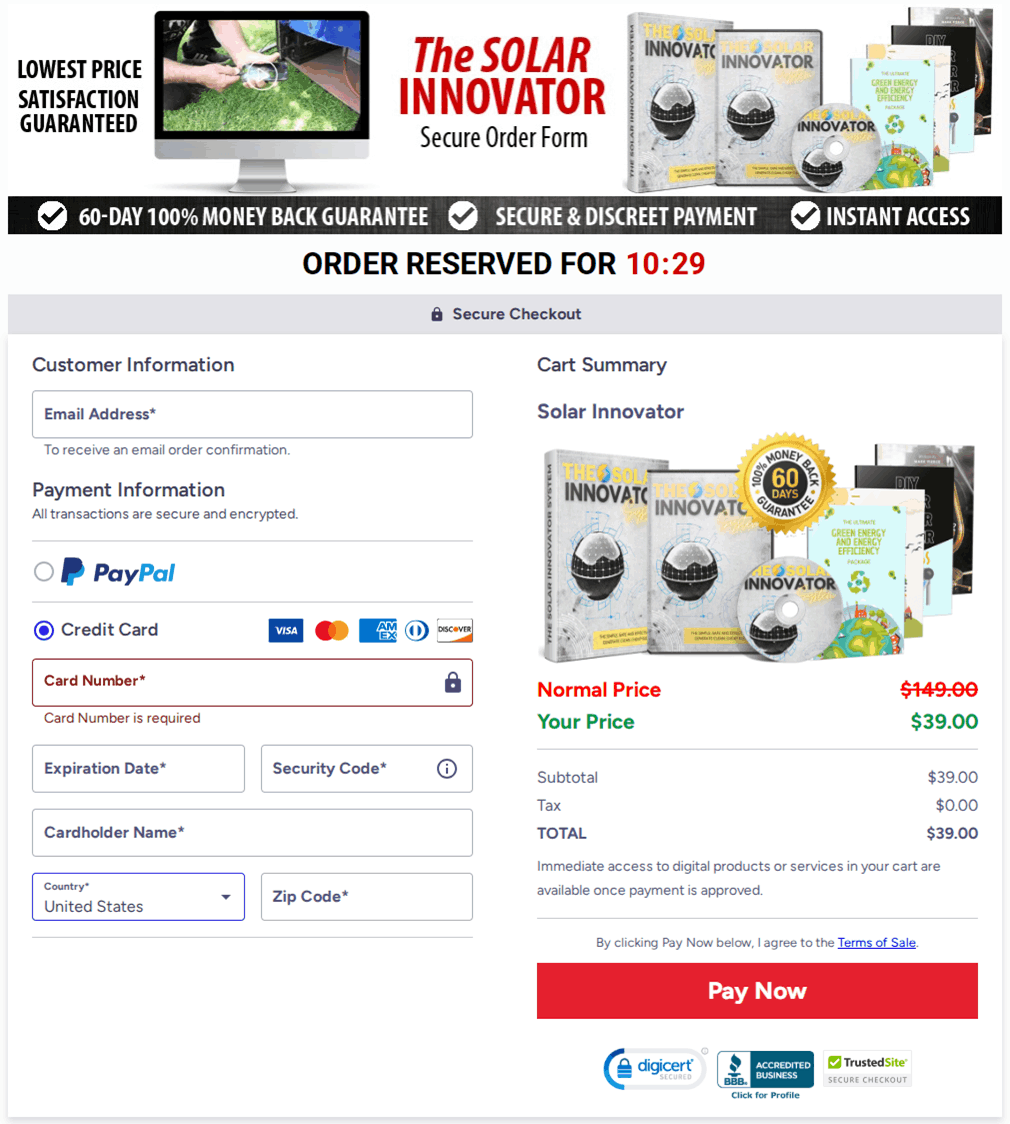
Price & Package Breakdown: Genuine Checkout Terms
Our review team inspected the official ClickBank payment gateway to document actual consumer pricing:
| Package | Checkout Price | Delivery Method | Ongoing Subscriptions |
|---|---|---|---|
| Solar Innovator System Complete DIY Guide & Video Blueprint | $39.00 | Instant Digital Download (PDF & Video) | $0.00 (One-Time Payment, Lifetime Access) |
The vendor anchors the retail value at $149. At $39 one-time, you receive unrestricted, instant digital access to the full schematics, video tutorials, parts lists, and companion guides. There are no shipping fees and no hidden recurring charges.
Bonuses & Companion Renewable Guides
Included with the primary $39 purchase are three supplementary digital bonus manuals designed to maximize household energy efficiency:
- Bonus 1: The Zero-Watt Home Appliance Guide: Practical strategies for identifying phantom electrical loads and slashing baseline household energy waste.
- Bonus 2: The Solar Battery Maintenance Handbook: Instructions on maximizing the lifespan and charge cycles of deep-cycle AGM and lithium batteries.
- Bonus 3: The Off-Grid Lighting Blueprint: Schematics for setting up low-draw 12V LED lighting systems that run indefinitely on solar battery reserves.
Guarantee: 60-Day ClickBank Refund Policy
The Solar Innovator System is protected by ClickBank’s standard 60-day, 100% money-back guarantee.
Because this is a 100% digital electronic product, you face zero return shipping costs or postal hassles. If you review the schematics and decide the assembly is beyond your interest or are unsatisfied for any reason, you can request a complete refund through ClickBank’s automated customer portal at clkbank.com within 60 days of purchase.
Customer Reviews: DIY Community Feedback & Video Test
Feedback from DIY builders and independent YouTube testing reflects positive outcomes when approached with realistic power expectations:
- Successful Weekend Projects: Handymen report successfully assembling the spherical generator in a single weekend, praising the clear diagrams and parts lists.
- Dependable Small Power: Users confirm that the unit reliably charges laptops, power tool batteries, drones, and emergency lighting systems during power outages.
- Criticism of Exaggerated Marketing: Reviewers emphasize that buyers should ignore hype about slashing power bills by 80%, appreciating the guide as an affordable educational project rather than a grid-replacement miracle.
Frequently Asked Questions
What is Solar Innovator and what comes with the program?
Solar Innovator is an electronic digital instructional package (PDF manuals, printable schematics, and video tutorials) that teaches you how to build a 3D spherical solar generator using affordable, readily available parts. It is not a pre-assembled physical solar generator shipped in a crate.
How does a 3D spherical solar design differ from flat panels?
Flat panels only capture optimal solar energy when the sun hits them directly perpendicular at midday. The 3D spherical design places small solar cells at multiple angles around a curved dome, allowing it to capture early morning light, late afternoon rays, and ambient ground reflections without mechanical tracking motors.
How much do the parts cost to build the system?
The materials—including small monocrystalline solar cells, lightweight spherical framing, diodes, wiring, a solar charge controller, and a compact 12V battery—typically cost around $150 to $200 at hardware stores or online electronics suppliers.
Can this system really cut my electric bill by 80%?
No. Sashing an entire home's electric bill by 80% requires large battery banks and heavy solar wattage (several thousand watts) capable of powering air conditioning and electric stoves. A small DIY sphere will power small appliances, laptops, emergency lighting, and power tools, delivering modest supplemental bill savings.
What is the refund policy on the Solar Innovator guide?
The guide is protected by ClickBank’s standard 60-day 100% money-back guarantee. If you decide the construction is too complex or are dissatisfied for any reason, you can request a full refund within 60 days of purchase through ClickBank's customer portal.
Is It Worth It? Bottom-Line Value Assessment
If you are an energy hobbyist, prepper, or handy homeowner looking for an engaging, educational blueprint to build an omnidirectional 3D solar generator for under $250 in total materials, Solar Innovator is well worth the $39 investment.
While promotional claims of eliminating 80% of your power bill are unrealistic, the bio-mimetic spherical design is thermodynamically clever and delivers legitimate off-grid utility. Backed by ClickBank's verified 60-day refund safety net, it offers a risk-free learning experience.
Final Verdict: A Clever DIY Solar Blueprint Behind Exaggerated Affiliate Hype
The Solar Innovator System is a well-structured DIY guide that introduces everyday homeowners to the benefits of 3D spherical photovoltaic design. By capturing sunlight from multiple angles throughout the day, it optimizes energy generation in compact spaces.
While affiliate promotional sites disgraced themselves by hosting recycled Orgone motor assets and making hyperbolic bill-slashing promises, the actual construction guide is practical and educational. At $39 with a 60-day money-back guarantee, it represents a fun and rewarding clean-energy project.
Buy / Order: Official ClickBank Purchase Portal
To access the authentic Solar Innovator System digital blueprints, video construction modules, and full 60-day money-back guarantee, order through the verified direct link below:
Download the Solar Innovator DIY Blueprints Today for $39
Access Solar Innovator Official Download Portal →Scientific Sources & Solar Engineering References
- Bernardi, M., et al. (2012). Solar energy generation in three dimensions. Energy & Environmental Science, 5(5), 6880-6884.
- Myers, P., et al. (2010). Geometric optimization of three-dimensional photovoltaic arrays. Journal of Applied Physics, 108(4), 044502.
- Skoplaki, E., & Palyvos, J. A. (2009). On the temperature dependence of photovoltaics: A review of relevant correlations. Solar Energy, 83(5), 614-624.
- Duffie, J. A., & Beckman, W. A. (2013). Solar Engineering of Thermal Processes (4th ed.). John Wiley & Sons.
Solar Innovator Video Review
This video is from the General Public Health YouTube channel. Title: “Solar Innovator Review 2026 Can This DIY Solar System Really Cut Your Electricity Bills?” Honest Supplement Review did not produce it and did not lab-test the product. Published Apr 2, 2026. Runtime 9m 36s.